What Should You Expect in Your First Year as a Spray Foam Contractor?
By Justin Jimenez, SprayAlliance Corp Your first year as a spray foam contractor will test your equipment decisions, your pricing strategy, your understanding of building codes, and your ability to...
What Should You Expect in Your First Year as a Spray Foam Contractor?
By Justin Jimenez, SprayAlliance Corp
Your first year as a spray foam contractor will test your equipment decisions, your pricing strategy, your understanding of building codes, and your ability to run efficient jobs with a lean crew. At SprayAlliance, we work directly with new contractors who want honest answers about what the first 12 months actually look like, fromspray foam startup cost projections to daily job-site realities. We focus on long-term performance, safety, and efficiency, not hype or inflated revenue promises. The contractors who build lasting businesses are the ones who invest in understanding the trade before they invest in the equipment.
Why Is Spray Foam a Strong Business Opportunity for New Contractors?
Demand for spray foam insulation has grown consistently over the past decade as energy codes tighten and property owners prioritize thermal performance. Residential retrofits, commercial builds, agricultural structures, and cold storage facilities all require insulation that delivers measurable air sealing and R-value in a single application. That consistent demand across multiple sectors is what makes this trade worth entering.
We help property owners achieve superior thermal performance by connecting them with contractors who have been properly trained and equipped. When you deliver quality work, referrals and repeat business follow. The opportunity is real, but sustainable profit depends on how you structure your operation from day one. Contractors who treat equipment, training, pricing, and operations as a connected system rather than isolated purchases are the ones who reach profitability fastest.
Is spray foam a good business to start?
This is one of the most common questions we hear. Margins are strong when overhead is controlled, demand spans residential, commercial, and agricultural markets, and repeat business is common once you establish a reputation for quality installations. Structuring a lean operation from the beginning is what determines long-term profitability.
What Does a Realistic Spray Foam Startup Cost Look Like?
One of the biggest concerns for anyone entering this industry is the upfront investment. Traditional setups, large trailer rigs, heavy-duty trucks, generators, and compressors, can push startup costs well past six figures before you spray a single job. Add insurance, materials, training, and licensing, and the number climbs further.
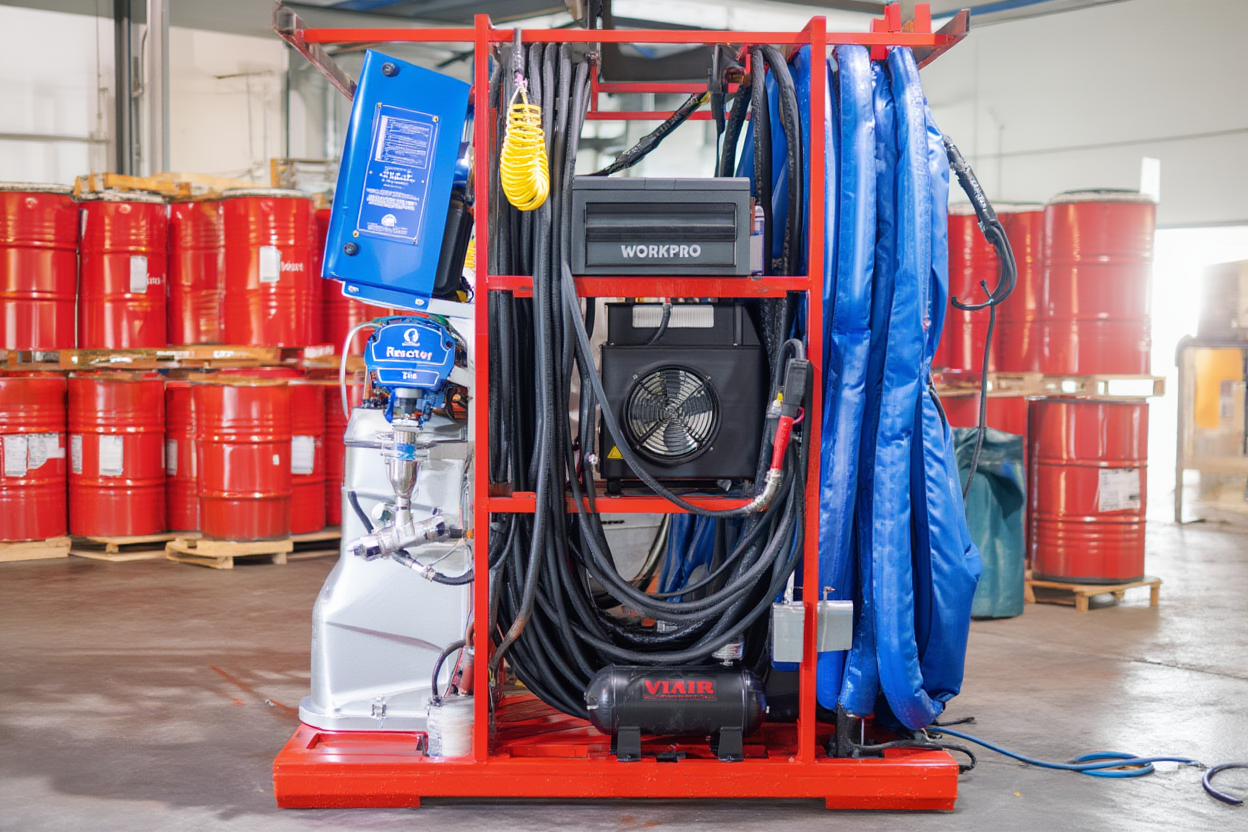
We at SprayAlliance engineered our systems to reduce that barrier significantly. Our rigs are built around the Graco Reactor 3 platform and designed to be compact and self-contained. That means you can mount your entire operation inside a standard cargo van or pickup truck, eliminating the cost of a dedicated trailer and the specialized tow vehicle it demands. From our facility in Stamford, CT, we build every rig to match the contractor’s target market and crew size, because the right equipment at the right price point is the single most important financial decision you will make in year one.
This approach saves money beyond the initial purchase. Smaller rigs mean lower fuel costs, lower insurance premiums, and less wear on your vehicle. Over the life of the business, those savings compound. A contractor running asmall spray foam rig with a two-person crew and two to three residential jobs per week is building real income without the burden of a large payroll.
spray foam startup cost
How Do You Choose the Right Spray Foam Rig for Your First Year?
The rig you select defines the scope of work you can take on. A trailer-based system limits you to jobs with easy vehicle access and open staging areas. A compact, van-ready rig opens up interior renovations, high-rise mechanical rooms, tight crawl spaces, and retrofit projects in occupied buildings, jobs that larger operators physically cannot bid on.
Our team specializes in building rigs engineered for the realities of modern contracting. For contractors evaluating aspray foam rig for sale, the most important factors are whether the system handles both open cell and closed cell chemistries, maintains consistent temperature and pressure at the gun, and operates reliably with a small crew. Our rigs use the Graco Reactor 3, which includes Katalyst software for automated yield optimization, core electric transfer pumps that prevent dry-cycling, and a large touchscreen interface that keeps every parameter visible in real time.
Aportable spray foam rig from SprayAlliance is not a stripped-down version of a larger system. It is a purpose-built, professional-grade machine that fits through a standard twenty-four to thirty-six inch doorway. When your rig can access spaces that trailer-based competitors cannot reach, you win contracts they cannot even bid on. That mobility advantage compounds throughout your first year as you build a reputation for accessing difficult job sites across markets like the tri-state region and beyond.
How much does a spray foam rig cost?
A professionalspray foam insulation equipment for sale package typically ranges from thirty thousand to over one hundred thousand dollars depending on proportioner, hose length, and whether the system is trailer-mounted or van-ready. Compact, self-contained rigs from SprayAlliance significantly lower that entry point while delivering the same professional-grade output as larger systems.
What Training and Certification Do You Need Before Your First Job?
Equipment alone does not make a contractor.Spray foam training and certification is what separates a person with a machine from a professional who understands building science, chemical behavior, substrate preparation, and code compliance. Contractors who invest in proper training before taking their first job avoid the most expensive mistakes in this industry.
Our training programs at SprayAlliance cover hands-on application technique alongside the business knowledge you need: how toprice spray foam insulation accurately, how to manage material yield, how to communicate with inspectors, and how to handle callbacks. We designed our curriculum so that a contractor who completes it can walk onto a job site confident in both the technical and operational sides of the work. Contractors throughout New York, New Jersey, and Connecticut and across the country have launched their businesses through our programs. The difference between a contractor who trained properly and one who skipped that step shows up on every job site. Proper training reduces material waste, prevents costly rework, and builds the kind of professional credibility that inspectors and property owners notice immediately.
What Building Codes and Safety Standards Apply to Spray Foam Installations?
Every spray foam installation is subject to building codes governing fire safety, thermal performance, vapor control, and occupant protection. The International Building Code and International Residential Code establish baseline requirements, but local jurisdictions frequently adopt amendments that add or modify those standards. A contractor who does not understand the code environment in their service area is operating at serious risk.
Spray foam insulation requires an approved thermal barrier, typically half-inch drywall, when applied in occupied spaces per NFPA and IBC requirements. Closed cell spray foam at specific thicknesses can function as a vapor retarder, which may eliminate the need for a separate vapor barrier depending on climate zone and wall assembly.Open cell vs closed cell spray foam selection directly affects how you approach vapor management on every project.
Inspectors are paying closer attention to spray foam installations than they did five years ago. They verify thickness with depth gauges, review product technical data sheets, and check thermal barrier compliance. Contractors who arrive on site with proper documentation, correct application thickness, and a clear understanding of local code amendments build credibility with inspectors. That credibility means smoother projects and faster sign-offs on every job that follows. Understandingspray foam building codes also means accounting for the time and materials required for full compliance, not just the spray itself.
spray foam startup cost
How Does a Lean Spray Foam Operation Maximize First-Year Profit?
In most trades, scaling up means hiring more people. Traditional spray foam operations have always pushed contractors toward bigger crews because oversized equipment demanded extra hands just to move and manage the rig. That model works, but labor costs eat into margins from day one.
We designed our systems so that a single operator or two-person crew can manage every aspect of a job. The Graco Reactor 3 platform includes Katalyst software that automatically optimizes spray yield and prevents ratio issues in real time. Core electric transfer pumps sense when a drum is empty and shut down the system before damage occurs. These features mean you do not need a dedicated technician monitoring the machine while you spray. The Reactor 3’s large touchscreen interface keeps all spray information on a single screen, and Reactor Connect’s cellular connectivity lets you monitor machine data from your phone even when you are off-site. For contractors serving the Stamford, CT area and throughout the Northeast, this lean model is especially effective because urban and suburban job sites often have limited staging space that favors compact equipment.
Contractors operating across Fairfield County see this advantage play out daily. In Stamford, tight commercial corridors and multi-story residential projects reward compact rigs that can stage in a parking space rather than a loading dock. Greenwich presents steady demand from high-end residential renovations where homeowners expect minimal disruption and clean, professional work. Norwalk’s mix of older housing stock and growing commercial development along the I-95 corridor creates a consistent pipeline of retrofit and new construction projects that a lean two-person crew can service efficiently without competing against the scheduling limitations of larger outfits.
The financial advantage of this approach is straightforward. When you understandhow much do spray foam contractors make versus what they spend, the math favors lean operations. Lower equipment costs, lower fuel, lower insurance, and a smaller crew translate directly into higher net profit per job. That margin advantage in your first year is what funds your growth into year two.
What is the average profit margin for a spray foam contractor?
Profit margins for spray foam contractors typically range from thirty to fifty percent depending on overhead structure, material costs, and job efficiency. Contractors running compact, self-contained rigs with small crews retain a larger share of revenue because their fixed costs are significantly lower than operators using traditional trailer-based setups with larger teams.
How Does SprayAlliance Support Contractors Through Their First Year?
Every challenge covered in this article, startup costs, equipment selection, training, pricing, and code compliance, connects directly to what we provide at SprayAlliance. We do not sell equipment and walk away. We build relationships with contractors who want to enter this industry prepared and grow on a solid foundation. To learn more about ourspray foam insulation equipment for sale and training programs, visit our equipment and services page.
Our solutions include compact, van-ready rigs built on the Graco Reactor 3 platform, hands-on training and certification programs covering application technique and building science, ongoing technical support for equipment and field issues, and practical business guidance on pricing, estimating, and operations. We also providespray foam equipment repair support, replacement parts, and material sourcing guidance so that when something goes wrong in the field, you have a direct line to a team that understands the equipment and the work. You can explore our full training and support resources to see how each service fits your situation.
What Is Your Next Step?
Starting a spray foam business is a serious decision that deserves serious preparation. At SprayAlliance, we have built our entire operation around helping contractors make that transition with the right equipment, the right training, and the right support. No hype. No pressure. Just a clear path from where you are now to a functioning, profitable spray foam operation.
To learn more about our equipment, training programs, or to talk through your specific situation with our team, visit us atsprayalliance.com